Whirling Dervish Dance

Chris Isidore
| 27-08-2026
 · Art Team
The Whirling Dervish performance is a highly structured cultural tradition associated particularly with Konya,
Its distinctive presentation combines controlled turning, precise footwork, extended arms, flowing garments, and traditional music to create a visually compelling form of cultural expression.
Although the movements may appear effortless, the technique requires coordination, balance, timing, and extensive preparation. Each component contributes to a carefully organized performance in which physical movement and music work together.
The Origins of the Tradition
The tradition is closely associated with the Mevlevi Sema, a formal performance tradition that developed in Konya during the late 13th century. Over time, its movement patterns, musical repertoire, costume, and performance sequence became established features of the tradition.
The Mevlevi Sema was inscribed on UNESCO’s Representative List of the Intangible Cultural Heritage of Humanity, reflecting its cultural importance.
Konya remains closely associated with the tradition, while performances are also presented in cultural settings across and internationally.
The Turning Technique
The characteristic rotation begins from a controlled stance rather than with immediate rapid spinning. The performer uses the left foot as the principal pivot, while the right foot helps propel the body around it.
Successful execution depends on maintaining a stable axis while coordinating the feet, torso, head, and arms. The performer gradually develops this technique through practice, learning to sustain the rotation without compromising posture or timing.
The Characteristic Arm Position
The arms provide one of the performance’s most recognizable visual features. During the turning sequence, they are generally extended with one hand raised and the other lowered.
This arrangement creates a balanced silhouette while contrasting with the continuous movement of the lower body. The controlled position of the upper body also helps give the performance its distinctive visual character.
Balance and Precision
Repeated rotation requires careful management of posture, balance, and body alignment. The performer must remain centered while maintaining a consistent relationship with the musical rhythm.
The traditional technique also involves keeping the eyes open but relatively unfocused. This contributes to the characteristic appearance of the turning sequence.
Developing these skills takes sustained practice. Precise foot placement and controlled posture are essential for maintaining a smooth performance.
Traditional Clothing
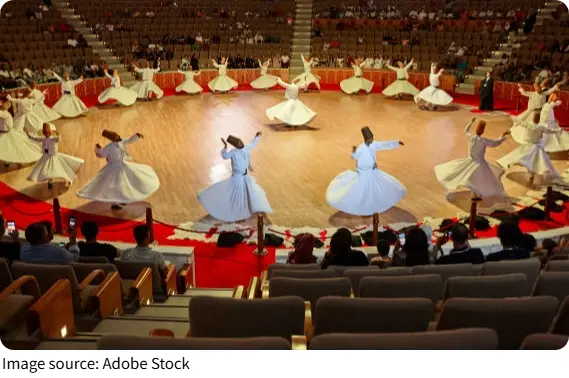
Costume is an integral part of the visual presentation. Performers wear long, flowing garments that expand outward during rotation, making the movement particularly visible.
The tall felt hat, known as a sikke, is another distinctive feature of the traditional costume.
The wide lower garment responds naturally to the turning motion, creating a broad circular shape around the performer and enhancing the visual effect of the choreography.
Music and Instruments
Music provides the performance with its rhythmic and structural foundation. The traditional repertoire, known as ayin, incorporates both vocal and instrumental sections.
The ney, a traditional reed flute, is an important instrument within the ensemble. Percussion instruments also contribute to the rhythmic structure.
The music and movement are closely coordinated, giving the performer a framework for timing and progression rather than serving merely as background accompaniment.
Rhythm and Repetition
The performance uses repeated turning to establish a continuous visual pattern. Musical development provides variation within this structured sequence, allowing the presentation to progress without relying on dramatic changes in movement.
Consistency is more important than speed. The performer must maintain timing, alignment, and control as the sequence unfolds.
Training and Discipline
The apparent simplicity of the turning technique conceals a demanding training process. Historical preparation associated with the tradition included movement, music, etiquette, and other areas of instruction.
Training within Mevlevi lodges was historically associated with a 1,001-day period, illustrating the depth of preparation traditionally connected with the practice.
Physical preparation involves coordinating footwork, rotation, posture, arm placement, breathing, and musical timing. These skills must work together naturally for the performance to appear fluid.
A Unified Cultural Performance
The strength of the Whirling Dervish tradition comes from the relationship between its individual elements.
Footwork establishes the rotation, the arms create its recognizable silhouette, and the flowing costume accentuates the movement. Traditional music supplies rhythm and structure, while disciplined preparation allows the performer to coordinate the complete sequence.
Together, these features create a performance that is both technically precise and visually distinctive.
The Tradition Today
The Whirling Dervish tradition continues to be presented in and internationally. Konya remains an important location associated with the performance, while cultural presentations introduce it to audiences in different settings.
Presentations can vary according to venue and format, but recognizable features include controlled turning, traditional costume, musical accompaniment, and carefully coordinated movement.
Its continued presence demonstrates how established performing techniques can remain relevant to contemporary audiences while retaining their distinctive cultural character.
What Makes It Distinctive?
The performance is defined by several closely connected features:
- Controlled rotation forms its central movement.
- Precise footwork supports stability and direction.
- Extended arms create its recognizable silhouette.
- Flowing garments emphasize the circular motion.
- Traditional music establishes timing and structure.
- Repetition provides continuity.
- Disciplined training enables consistent execution.
These elements are most effective when experienced together, creating a performance whose visual identity depends on the relationship between movement, music, costume, and technique.
The Whirling Dervish performance is a sophisticated example of traditional cultural expression. Its distinctive character comes from the careful integration of rotation, footwork, posture, costume, music, rhythm, and training.
What appears to be a simple turning movement is supported by precise technique and sustained preparation. Through the interaction of movement and music, the performance creates a distinctive visual form that continues to introduce audiences to an important part of cultural heritage.