The Art of Fencing

Arjun Mehta
| 08-05-2026
 · Sport Team
Fencing is often perceived as fast, elegant, and mysterious, yet at its core, it is a sport of strategy and control.
Lykkers, this discipline is not merely about quick hands; it demands mastery of distance, timing, rhythm, and clever tactics. One moment you stand still, and in the next, your entire plan unfolds in a flash.
Much like chess in motion, fencing requires reading your opponent, concealing your intentions, defending your space, and striking at precisely the right moment. Whether your goal is to take a beginner class or to better understand the sport, developing confidence on the piste starts with understanding these principles.
Thinking Like a Fencer
Success in fencing stems from recognizing that every action has a purpose. This sport teaches control of space, composure under pressure, and the ability to provoke reactions from your opponent before they are ready.
Fencing features three primary styles: foil, epee, and sabre. In foil, precision is paramount. Touches count only on the torso, and right-of-way rules determine scoring priority, making it ideal for learning clean technique and disciplined attacks. Epee expands the target area to the entire body, and simultaneous hits allow both fencers to score, encouraging a measured, strategic approach. Sabre is fast and dramatic, with above-the-waist touches and right-of-way rules governing priority, demanding speed, decisiveness, and explosive movements. For beginners, any style can serve as a foundation, though selection should consider personal interest, coaching availability, and the club environment.

Mastering Distance and Timing
Many beginners assume that speed alone ensures success, yet fencing is first and foremost about distance. Proper distance determines whether an attack lands or fails. To gauge it, fencers often perform a reach test: extend the arm in guard position. If the point reaches the target without stepping, the distance is sufficient; one step indicates attacking range, and several steps require a preparatory approach. Distance is a form of information—it informs every decision, from advance to lunge, and prevents wasted or premature movements.
Footwork, Lunges, and Balance
While hands draw attention, the foundation of effective fencing lies in the feet. Controlled advances, retreats, lunges, and recoveries create opportunities and maintain balance. Beginners should practice with knees relaxed, the front foot pointing forward, and the back foot angled slightly outward. Movement must be deliberate: the front foot leads during advances while the back foot follows, and the reverse applies when retreating. Quiet, deliberate footwork ensures stability and preserves reaction time.
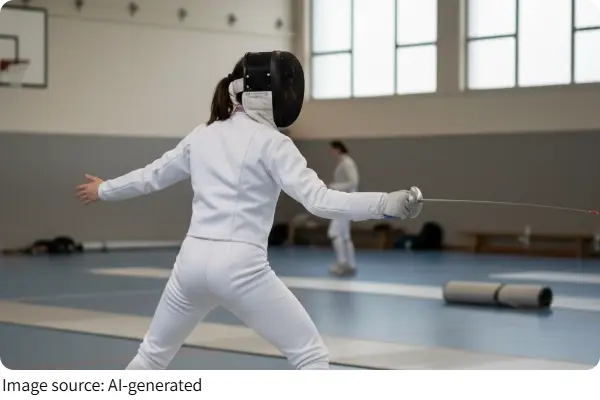
The lunge is a central action in fencing and can be conceptualized as a sentence: extend, land, score, and recover. Extend the arm first, drive forward with the front leg, and support with the back leg. Proper alignment of the front knee and immediate recovery to guard position are critical; failure to recover is a common cause of lost points.
Maintaining Composure
Fencing masks can feel confining, which may initially affect breathing and posture. Beginners should consciously relax the jaw and breathe steadily to prevent tension, which slows reaction time. A calm fencer can adjust strategy mid-bout and respond more effectively to unexpected movements. Before each exchange, taking a brief moment to inhale, exhale, and check posture and grip can significantly enhance focus and performance.
Strategic Training
Improvement in fencing does not require endless sparring. Instead, focus on habitual precision, observation, and repetition of clean movements. Short, focused practice sessions should include controlled footwork, balanced lunges, and reaction exercises to sharpen reflexes. Equally important is learning to read opponents’ tendencies: some fencers consistently retreat, rush forward, or repeat patterns. Identifying a single habit can provide a strategic advantage.
Feints and Blade Control
A successful feint is subtle and strategic, never exaggerated. By creating a believable but deceptive movement, fencers can provoke premature reactions and exploit openings. Maintaining a relaxed and precise grip allows smoother actions, faster defensive responses, and more accurate attacks. The hand should guide with control rather than force, enabling quick adjustments during exchanges.
Observational Learning
Watching fencing at a high level can be overwhelming due to the speed of exchanges. To learn effectively, focus on specific elements: control of distance, timing of attacks, and speed of recovery. Slow-motion analysis is invaluable, enabling anticipation of opponent movements and reinforcing observational skills essential for tactical growth.
First Steps at a Club
Beginner fencers should wear athletic clothing and clean indoor shoes and bring water. Clarify whether the club provides gear and always adhere to safety protocols. Expect initial clumsiness—it is normal when mastering unfamiliar movement patterns. The priority for your first sessions is to internalize proper stance, movement, and situational awareness rather than winning points. Respect, attentiveness, and curiosity are appreciated qualities that facilitate a welcoming experience at any fencing club.
Life Lessons from Fencing
Beyond the sport itself, fencing teaches discipline, patience, and adaptability. Minor adjustments often have significant consequences, and measured restraint frequently outperforms raw energy. The sport instills respectful competition through salutes, adherence to rules, and acceptance of outcomes. Lykkers, approaching fencing with curiosity and respect for the fundamentals allows every bout to enhance not only skill but also strategic thinking and personal growth.