Surprising Coyote Facts

Caroll Alvarado
| 10-03-2026
 · Animal Team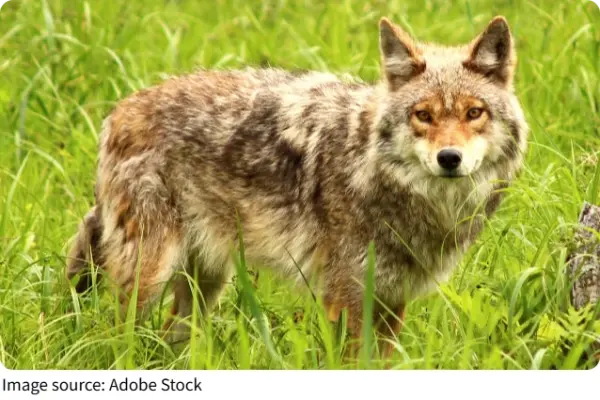
Have you ever paused on a quiet trail at dusk and heard a series of yips, howls, and barks drifting through the trees?
If you have, there's a good chance those sounds came from a coyote — a wild canine that has captured human curiosity for centuries.
With its distinctive mask like face and bushy tail, the coyote (Canis latrans) is one of North America's most adaptable mammals, thriving in environments ranging from open plains to urban neighborhoods. But beyond its recognizable appearance, coyotes exhibit an array of behaviors and traits that make them uniquely successful survivors in a changing world.
From their remarkable diet and social dynamics to their ability to coexist with humans, coyotes offer exciting insights into animal behavior and ecosystem balance. Below, we explore some of the most interesting facts about Canis latrans, drawing on scientific sources that reveal both their cunning and ecological importance.
Physical Characteristics and Range
1. Size and appearance
Coyotes stand about 60 cm (24 inches) at the shoulder and typically weigh between 9 and 23 kg (20–50 pounds). Their bodies are slender and lightly built compared to wolves, with long legs and a bushy tail tipped in black. Fur coloration can vary considerably across populations, but it is generally grizzled buff above and whitish below, providing camouflage in a variety of habitats. ([turn0search0])
2. Wide geographic distribution
Historically found in prairies and deserts, coyotes have expanded dramatically across North America. Today they inhabit most of the United States and Canada, from forests and mountains to cities and suburbs. This range expansion highlights their adaptability to diverse environments, including human modified landscapes. ([turn0search1])
3. Nocturnal and agile
Coyotes are primarily nocturnal, meaning they are most active at night. They can run up to about 64 km/h (40 mph), enabling them to chase prey or retreat quickly from threats. Their keen hearing and sense of smell aid in detecting food and sensing danger even in low light conditions. ([turn0search0])
Diet and Foraging Behavior
1. Opportunistic omnivores
Although classified in the order Carnivora, coyotes are omnivorous and will consume a wide variety of foods. Their diet includes mammals such as rodents, rabbits, and hares, as well as insects, birds, reptiles, fruit, and carrion. This versatility allows them to adjust their food choices depending on availability. ([turn0search1])
2. Hunting strategies
Coyotes use different tactics when hunting based on prey size and environmental conditions. For small mammals like mice and rabbits, they quietly stalk and then pounce with precision. In contrast, larger prey such as deer may involve cooperation among multiple individuals, increasing the likelihood of a successful hunt. ([turn0search11])
3. Eating habits in different seasons
Seasonal changes influence what coyotes eat. In fall and winter, when small mammals are harder to find, coyotes may consume more vegetation, berries, and fruit. Their ability to switch between animal and plant foods is a key factor in their survival across regions. ([turn0search11])
Social Structure and Reproduction
1. Family groups and packs
Coyotes are typically territorial and can live either alone or in family units. During fall and winter, they may form small packs to improve hunting efficiency. These social groups often include a breeding pair and their offspring, which helps in defending territory and raising pups. ([turn0search1])
2. Breeding and pups
Coyotes generally mate in late winter to early spring. After a gestation period of about 58–65 days, females give birth to litters of four to seven pups. Young coyotes are born blind and helpless but begin exploring outside the den after a few weeks. Both parents participate in feeding and caring for the young until they become independent in late summer or fall. ([turn0search0])
3. Longevity and survival
In the wild, coyotes rarely live beyond six to eight years due to natural causes and human impacts such as vehicle collisions. In captivity, however, they can live much longer, sometimes exceeding 20 years. Their resilience in the face of challenges — including hunting pressure — reflects their adaptability as a species.
Adaptation and Human Coexistence
1. Thriving in urban areas
One of the most remarkable aspects of coyotes is their ability to thrive in urban and suburban regions. They adjust their activity patterns to avoid humans and opportunistically use food resources such as garbage, pet food, and small domestic animals. Although they generally avoid people, their presence in cities like Los Angeles and Chicago illustrates their flexibility.
2. Ecological role
Coyotes play an important role in their ecosystems by controlling populations of small mammals like rodents and rabbits. This predation helps maintain balanced trophic interactions and supports vegetation health. In areas where coyotes are absent, small mammal populations can grow unchecked, leading to habitat degradation.
3. Misconceptions and management
Despite their ecological importance, coyotes have often faced persecution due to conflicts with livestock producers and pet owners. However, modern wildlife management recognizes their adaptability and ecological contributions, leading to more nuanced approaches that aim to balance human and wildlife needs.
Coyotes are emblematic of nature's ability to adapt in a changing world. Their intelligence, dietary flexibility, and social behavior reveal a species finely tuned to survival across diverse landscapes. Observing Canis latrans invites us to appreciate not just their cunning as hunters or foragers, but their role in the intricate web of life shared with humans and other animals.